
 Deutsch
 Français
 English
TermBoy researches the terms; term injection enforces them. For every machine pre-translation, TTN TMS looks up the matching entries in the client’s termbase for each segment and inserts them into the translation prompt as a binding specification. As a result, every AI translates a technical term the same way – in every segment, in every order and with every provider.
One Word, 27 Translations
The German word “Läufer” has 27 possible translations in English. In an electric motor, a Läufer is a rotor; in a water turbine, a runner; on a zip, a slider; in masonry, a stretcher; on a ring spinning frame, a traveller; on a slide rule, a cursor; and on a chessboard, a bishop.
Without a specification, the AI decides afresh with every call which of these options to choose – depending on the context of the sentence, the provider and even the computing time available at that moment (see chapter “TM-Augmented Translation”). The same maintenance manual then says “rotor” in one place, “armature” a few pages later and “runner” in the next order. To the reader, these are three different components.
How Term Injection Works
The client’s termbase specifies for the subject field electric motor: Läufer → rotor. When TTN TMS detects the term in the segment “Den Läufer vor der Wartung ausbauen.”, the specification “Läufer = rotor” is injected into the AI request. Claude, ChatGPT and DeepL phrase the sentence differently – “Remove”, “Take out”, “Dismantle” – but all three translate “Läufer” as “rotor”.
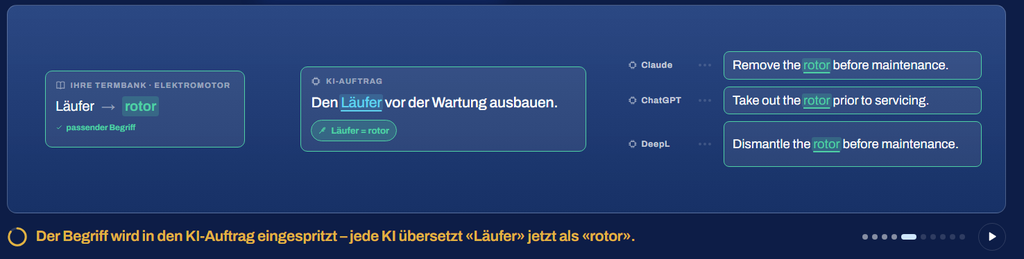
Figure 69: Term injection – the termbase entry “Läufer → rotor” is injected into the AI request
Term injection always inserts the same terms: for the same source term, the same termbase always supplies the same specification. The wording of the sentence may vary; the technical term may not.
Full Control for Client and Translator
The terminology belongs to the client. The client can change or reject any term, or have new terms added, at any time – via the TermBoy approval workflow or simply by notifying TTN. Every change takes effect from the next pre-translation, for all AI providers at once.
The translator has direct control via the CAT tool and MultiTerm. In the Trados editor, the translator sees for each segment which termbase entries apply. If a term is missing or a translation needs correcting, the translator enters it directly in MultiTerm. TTN TMS transfers the entry to the client’s termbase, and TermBoy automatically adds the definition, images and further details. From the next order on, the new or amended term is injected.
The Benefits of Consistent Terminology
1. One term, one object. Readers of manuals, spare-parts catalogues and safety instructions must be able to rely on the same word always meaning the same thing. Changing designations lead to queries, incorrect orders and, in the worst case, operating errors.
2. Independent of the AI provider. Whether Claude, ChatGPT, DeepL or a future model: the terminology stays the same. Switching provider changes the wording of the sentence, not the technical terms.
3. Less revision effort. The proofreader no longer has to correct technical terms segment by segment; the QA check reports only genuine deviations. This saves time and costs on every order.
4. Greater reuse. Consistently translated terms increase the match rate in the translation memory: what is translated consistently today is a 100 % match tomorrow.
5. Traceability. The log of every order shows which terms were injected. In the event of queries, audits or legal investigations, the origin of a translation can be proven.
6. Consistent corporate identity. The client’s corporate language is used identically across all languages, documents and channels – from the catalogue and the website to the answer of a chatbot that relies on the published terminology.